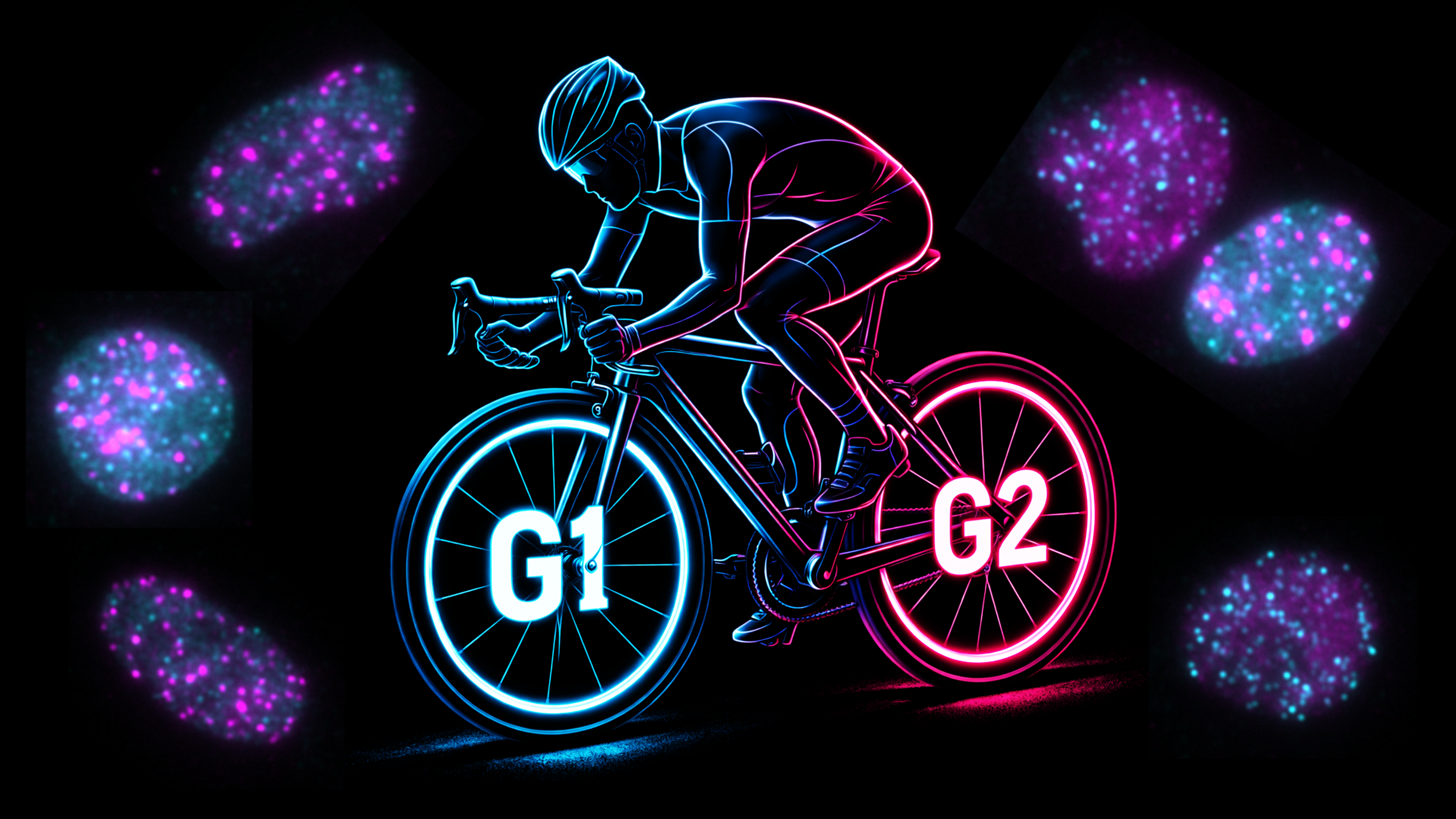
What cancer cells can teach us - by seeing them as cyclists
This talk will explore how we can make cancer cells crash, while letting healthy cells stay protected. Imagine cells as a cyclist pedaling through the stages of the cell cycle race on the way to the finish line: division.
To stay safe, the cyclist relies on two brakes: the front ‘G1’ brake and the rear ‘G2’ brake. Healthy cells use both reliably, stopping early if something looks wrong. Cancer cells, however, behave like reckless riders. Obsessed with speed, they’ve removed their G1 brake and charge ahead even when their ‘bike’, their DNA, is damaged. Yet they still depend on the G2 brake to avoid catastrophic crashes.
In this talk, I will share with you how we study targeted treatments that exploit this weakness. By the time we’re done, you will know how we can force cancer cells into a fatal crash, while healthy cells stay protected thanks to their intact G1 brake.
(AI-illustration: Jan Benada/ChatGPT)